


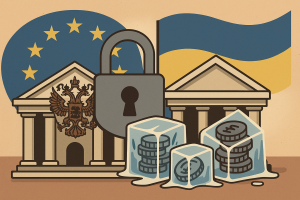
Freezing Russian state and private assets and supporting Ukraine: legal foundations, financial instruments, mechanisms and options for implementation



Vol. 20, No. 7 (2025) · Article 902
-
Russia’s aggression against Ukraine on 24 February 2022 fundamentally shook the European security order and prompted the EU and the G7 to develop normative, legal, and financial innovations to mobilise frozen Russian assets in support of Ukraine.
-
The range of possible measures is legitimised by the reparative logic of state responsibility and the UN General Assembly’s call of November 2022; however, because of central bank immunity, outright confiscation of principal is more legally and financially hazardous than the proportionate and reversible allocation of the extraordinary proceeds generated by those assets.
-
Sovereign foreign-exchange reserves are held through cross-border custody and settlement chains; due to Russia’s euro exposure, the largest share is booked in Belgium at Euroclear, with a smaller portion in Luxembourg at Clearstream, concentrating legal and reputational burdens particularly on these jurisdictions.
-
The EU and the G7 can operationalise a gradual, two-pillar model: the principal remains frozen, while “extraordinary net profits” can be channelled to Ukraine, and the future cash flows from those profits can underpin both the ERA loan and a contested, larger EU-level “reparations loan” structure.
-
The long-term viability of this architecture depends on whether financial stability risks and litigation exposure remain manageable; this requires prudential buffers, liability-limiting rules, and a strictly conservative reinvestment approach.
- The “Russia pays first” principle can be designed as an ex ante, rule-based mechanism that operates automatically, but in political terms it is likely to become realistic only as part of a comprehensive, package-type settlement.
Russia’s aggression launched on 24 February 2022 against Ukraine has fundamentally called into question the European security order and has forced the sanctioning coalition to search for new solutions in normative, legal and financial terms.
One of the most important components of the European Union’s response has been the issue of the wide-ranging freezing of Russian sovereign and private assets. The classical rule of state responsibility – the full reparation obligation of the internationally wrongful state – together with the reparations framework set out in the UN General Assembly’s November 2022 resolution, provides a basis for the freezing of assets, in particular in view of the establishment of a register of damage which may serve as the foundation for later payments (UNGA, 2022: §§3–9). The legal framework is supplied by those provisions of the International Law Commission’s Articles on State Responsibility which permit countermeasures in cases of serious breaches, interpreted in light of the principles of necessity and proportionality. At the same time, the long-standing practice of exempting central bank assets from execution is widespread, which makes outright confiscation of principal significantly more risky than the allocation of returns or the use of such returns as the basis for financing (ILC, 2001: Arts 31–36, 49–54; Milanović, 2022; Bruegel, 2024).
This dual requirement – reparative justice and systemic stability – explains why the EU and the G7 have, over the past two years, developed a gradual, two-pillar solution that preserves the inviolability of sovereign capital while prioritising the public-interest use of the extraordinary returns generated on that capital and the channelling of those returns into loan-based instruments (EU Council, 2024; G7 Leaders, 2024; Brookings, 2025).
The path of Russian state assets to Belgium and Luxembourg
The management of sovereign foreign-exchange reserves in the modern financial system is by its nature a cross-border activity. Central banks and sovereign wealth funds do not hold their reserves as “domestic bank deposits”, but through international clearing and custody chains – partly with other central banks (for example, the European Central Bank or the U.S. Federal Reserve System), partly with the Bank for International Settlements (BIS) in Basel, and partly with international central securities depositories (ICSDs), above all Euroclear and Clearstream. The primary purpose of reserves is to ensure external liquidity in the face of balance-of-payments shocks, exchange-rate volatility and other emergencies. Such interventions can be effective only if funds are directly accessible on foreign markets that are both legally and technically reliable. This is complemented by the requirement that reserves be held in high-quality, rapidly mobilisable instruments (short-term government securities, central bank accounts, overnight deposits, central-bank-eligible collateral).
Brussels is the seat of Euroclear Bank, which has historically become the key settlement node for the global eurobond market and for euro-denominated sovereign debt. Where a sovereign portfolio has a large euro exposure (EU government securities, eurobonds, short-term euro instruments), payments, interest income and principal redemptions flow through the Euroclear settlement chain, so that the jurisdiction of record appears to be Belgium. The fact that sovereign euro assets are booked in Belgian or Luxembourg institutions does not mean that the underlying assets legally “belong” only to those jurisdictions. In the euro area, Euroclear (Belgium) and Clearstream (Luxembourg) are dominant; for dollar assets, New York (Fed/DTCC) is the natural hub, for sterling assets London (CREST/BoE), and for yen assets Tokyo. A sovereign’s choice reflects its preferred currency composition and product structure. After 2014, Russia deliberately reduced its dollar reserves and increased its euro share, which in turn raised the volume of assets held at Euroclear and Clearstream.
As a matter of general practice, sovereign reserves are broadly diversified: across several currencies (USD, EUR, JPY, GBP, etc.), several jurisdictions (US, euro area, United Kingdom, Japan), several institutional types (central bank accounts, BIS, ICSDs, first-tier custodians), different maturities and multiple financial instruments. Diversification mitigates legal, market and operational risks: if one channel “fails” or is restricted, liquidity can be provided through another. Nevertheless, concentration linked to the nature of the instruments is unavoidable: a large share of euro portfolios is held via Euroclear and Clearstream, while dollar reserves rely on the Fed and U.S. Treasury market infrastructures.
The question of insurability arises in relation to sovereign assets held abroad. Sovereign reserves are not covered by retail deposit insurance schemes, and classic political-risk insurance is not commercially viable at these volumes. Protection traditionally rests on three pillars: legal immunities (especially for central bank assets), strict asset segregation on the custodian’s books, and prudential principles (ultra-conservative placement, short maturities, high liquidity). This is complemented by jurisdictional and institutional diversification, which in practice functions as the closest analogue to “insurance”.
Options for using Russian sovereign and private assets
The scope and structure of the frozen Russian assets are now relatively well delineated. Globally immobilised Russian sovereign reserves – predominantly central bank assets – are estimated at EUR 260–300 billion, the bulk of which is concentrated under European jurisdiction (Brookings, 2025; Reuters, 2025). Within this, the largest share – approximately EUR 180–190 billion – is held under Belgian law at Euroclear Bank SA/NV in Brussels, an international central securities depository (ICSD). Clearstream Banking S.A. in Luxembourg – the Deutsche Börse Group’s ICSD – holds a smaller portion, estimated by analysts at around EUR 10–20 billion. A significant part of the Euroclear-held portfolio has already been converted into cash or cash-like claims, which has amplified its yield-generating capacity. In the United States, the stock of immobilised Russian central bank (sovereign) assets is around USD 5 billion, while in the United Kingdom the total value of frozen Russian assets is roughly GBP 25 billion, only a fraction of which represents central bank holdings. The Japanese government does not publish an official breakdown, but the previously disclosed currency composition of Russian reserves suggests a substantial yen exposure, implying that the assets immobilised under Japanese jurisdiction are on the order of several billion U.S. dollars (EPRS, 2025; Brookings, 2025; Reuters, 2025).
In addition to sovereign assets, the EU has frozen more than EUR 28 billion in private assets – bank accounts, securities portfolios held with custodians, movable and immovable property – on the basis of sanctions lists targeting specific individuals and entities. High-profile cases include seizures of large superyachts, such as the Amadea, Scheherazade or Dilbar.
With respect to private assets – in contrast to sovereign holdings – some jurisdictions do permit genuine confiscation and liquidation, subject to judicial control (European Commission, 2025; Business Insider, 2025; RFE/RL, 2025; The Times, 2022). The legal bases for confiscation, however, differ. In the United States, the REPO Act (Rebuilding Economic Prosperity and Opportunity for Ukrainians Act) has created a foundation for court-ordered confiscation; in the European Union, by contrast, the stronger constitutional protection of property rights has so far led lawmakers to focus on criminalising sanctions circumvention and confiscating assets derived therefrom, rather than on direct confiscation solely on the basis of listing.
A structural feature of the sovereign portfolios is that reserves initially held in the form of securities have, as a result of sanctions prohibitions, largely been transformed into cash and cash-like claims on the books of the ICSDs: principal and interest on maturing securities continue to be paid, but the designated beneficiary cannot access them. In a high interest-rate environment in Europe, the rising share of cash has by itself increased the yield-generating capacity of the portfolio (PIIE, 2024; Euroclear, 2024–2025).
In the negotiations on the use of frozen Russian state assets, Belgium has displayed particular caution. This is understandable, given that the concentration of sovereign assets in the EU places the heaviest legal and reputational responsibility on Belgian shoulders. Belgian concerns can be grouped under three mutually reinforcing headings. (1) Concentration risk – because the overwhelming majority of immobilised sovereign assets are at Euroclear, the legal and reputational burden falls disproportionately on Belgium. The European Commission itself emphasises that the use of returns requires buffer-building and cautious allocation (net proceeds of EUR 15–20 billion are expected by 2027), while the EU must take financial stability considerations into account alongside its legal exposure. (2) Legal and litigation risk – the Belgian government fears that more aggressive legal steps (direct confiscation of principal, riskier reinvestments) could trigger a wave of high-value damages claims from Russia and from private investors. Belgium has therefore consistently advocated the use of returns rather than principal, insisting on EU-level risk-sharing (liability-limiting norms, prudential reserves) and favouring solutions that leave the capital “untouched”. (3) Domestic political and fiscal sensitivity – the extraordinary profits earned by Euroclear on these assets generated roughly EUR 1.7 billion in corporate tax revenue for Belgium in 2024, part of which was channelled to Ukraine. This, however, has also fuelled criticism that Belgium is an indirect “beneficiary” of the war, further heightening domestic political caution. Together, these three factors explain Belgium’s careful positioning: it supports the EU-level use of net extraordinary returns (90% via the European Peace Facility, 10% via the Ukraine Facility) and of loan instruments backed by future returns, but rejects direct use of principal and insists on EU-wide burden-sharing and safety nets (buffers, liability caps) for implementation.
At the core of the technical-institutional measures lies the question of European financial market infrastructure. Amendments to Regulation (EU) No 833/2014 have de facto prohibited transactions with the Central Bank of Russia (CBR), prompting Euroclear and Clearstream – the two dominant European central securities depositories (CSDs) – to immobilise accounts linked to the CBR while extraordinary net returns from maturing securities and coupon payments accumulated on their books. These liquidity balances were invested in an extremely conservative manner in short-term, low-risk instruments – including accounts at the European Central Bank – generating substantial interest income. In May 2024, the EU adopted a legal framework to ring-fence this “extraordinary net income” and to allocate it in a targeted way for the benefit of Ukraine. Belgium complemented this with a special tax regime under which it levied corporate tax on the CSD’s extraordinary profits and pledged the proceeds largely to Ukraine (EU Council, 2024; EC Q&A, 2024; Brookings, 2025).
In parallel, EU and UK sanctions also targeted the Russian domestic financial market infrastructure, in particular the АО Национальный расчетный депозитарий (National Settlement Depository, NSD), Russia’s own central securities depository. The inclusion of NSD in the EU sanctions list has been upheld by the General Court of the European Union, while Russia has responded by restricting foreign investors’ access to the Russian custody chain. This has created a form of “bilateral” immobilisation, increasing the legal and reputational risk borne by European CSDs (OSW, 2024; General Court, 2024; Cleary, 2024). The situation is further aggravated by Russian court judgments that seek to circumvent sanctions domestically and to impose liability on Western custodians. These developments reinforce the EU’s case for building protective capital buffers and adopting liability-limiting legislation.
Because of changes in the European interest-rate environment, the volume of returns has grown rapidly. Euroclear booked around EUR 4.4 billion of extraordinary interest income on immobilised balances in 2023 and roughly EUR 6.9–7.0 billion in 2024; in 2024 Belgium collected around EUR 1.7–2.0 billion of tax on these profits and pledged the bulk of this to Ukraine (Euroclear, 2024–2025; Brookings, 2025). Extraordinary interest income amounted to nearly EUR 4.4 billion in 2023, EUR 6.9 billion in 2024, and EUR 2.7 billion in the first half of 2025. EU projections foresee net, buffer-adjusted proceeds of EUR 15–20 billion by 2027, providing a stable flow of resources for the European Peace Facility (EPF) and the Ukraine Facility. The first disbursement of EUR 1.5 billion was made on 26 July 2024, with 90 per cent allocated to the EPF and 10 per cent to the Ukraine Facility, followed by further transfers in 2025 (EC Q&A, 2024; Reuters, 2024; Kyiv Independent, 2025; EPRS, 2025). The essence of the scheme is that the capital remains frozen and untouched, while the returns, net of a prudential buffer, are channelled to Ukraine through clearly defined mechanisms.
The allocation of financial resources can be divided into three groups. The first consists of the direct, in-year transfer of returns to the EU’s two primary financing channels. Military-related support is provided via the EPF, which reimburses member states for arms deliveries to Ukraine and finances joint procurement – in particular for air defence, artillery and drone capabilities. The civilian-macrofiscal component is handled by the Ukraine Facility, which supports budgetary stabilisation, rapid reconstruction of the energy grid and institutional reforms on a milestone-based basis (EPRS, 2024–2025; AP, 2024).
The second mechanism is the approximately USD 50 billion Extraordinary Revenue Acceleration (ERA) loan endorsed at political level by the G7 in 2024. The ERA provides around USD 50 billion in loans to Ukraine on the understanding that, as with the EU arrangements, debt service – principal and interest – will be financed from the “extraordinary” returns generated on immobilised Russian sovereign (central bank) assets. The capital stock remains frozen; only returns are used as collateral. By accessing the discounted present value of future cash flows, significant resources are made available, while the sovereign principal remains immobilised. Legally, the construction is explicitly tied to the returns and embeds risk-sharing among the G7 members (G7 Leaders, 2024; Politico, 2024).
The third element – still under discussion in Europe in autumn 2025 – is a prospective EU-level “reparations loan” of some EUR 140–160 billion, to be backed by the future stream of returns on the Euroclear-held assets and by prospective reparations payments after the end of the war, again without touching the principal. This might be implemented via the European Investment Bank (EIB), the European Bank for Reconstruction and Development (EBRD) or other multilateral institutions. The scheme would rest on a robust system of guarantees and liability shields (Reuters, 2025; The Guardian, 2025; FT, 2025). From a legal perspective, these mechanisms are more defensible because they do not affect the most sensitive element of immunity – principal – while being sufficiently robust macro-financially to provide predictable funding over several years.
The choice between confiscating principal and using returns thus turns on the balance between international law constraints and financial stability considerations. From the standpoint of justice and deterrence, the state responsible for the aggression should bear the costs, a principle reinforced by the UN General Assembly’s call for the establishment of reparations mechanisms (UNGA, 2022: §§3–6). However, a “frontal” breach of central bank immunity – outright confiscation of principal – would undermine confidence in the reserve-currency system, invite accusations of “weaponising finance” and accelerate reserve diversification (Bruegel, 2024).
By contrast, the use of returns as a countermeasure is more proportionate and reversible: the principal remains intact, and payments can be suspended at any time, making this a more prudent route both legally and financially. Its drawback is quantitative: returns alone are more limited in scale, a constraint that ERA-type and EU-level loans seek to mitigate by mobilising the present value of future returns (ILC, 2001: Arts 48–54; G7 Leaders, 2024). Emerging practice also seeks to limit the litigation and regulatory exposure of intermediary institutions – CSDs and custodians – by building buffers and introducing liability-shielding norms. The underlying logic is to avoid steps – such as riskier reinvestment strategies or transfers to special-purpose vehicles (SPVs) – that could be characterised as de facto expropriation and trigger chain-reaction litigation (FT, 2025).
From the perspective of macro-financial stability, the returns-based model has the advantage of alleviating concerns about the integrity of the reserve-currency system and avoiding the kind of reserve-diversification “avalanche” that outright confiscation might provoke. The direct fiscal cost of this approach is that returns alone are smaller in volume, but, when aggregated and leveraged through loan instruments, they can underpin substantial, multi-year financing (Bruegel, 2024; Reuters Legal, 2024).
On the Ukrainian side, the use of financial resources falls into two broad categories. Under the military component, the EPF reimburses member states for the cost of weapons systems supplied to Ukraine, finances new procurements for air defence, artillery and UAVs, and allocates resources to expand Europe’s own defence-industrial production (EPRS, 2025; AP, 2024). On the civil-macroeconomic side, the Ukraine Facility provides EUR 50 billion in financing for 2024–2027, more than EUR 38 billion of which takes the form of direct budget support. Disbursement is tied to progress under the “Ukraine Plan” indicators and reform milestones; 10 per cent of the extraordinary returns is channelled here and can be used for energy-grid reconstruction, budgetary liquidity and project preparation (EPRS, 2024). Disbursement structures are transparent and tied to anti-corruption and public-procurement integrity conditions, so that the use of funds is intended to remain accountable and performance-oriented.
Automating reparations payments: the legal-institutional framework
The chief advantage of the G7 ERA and the proposed EU reparations loan is that, once the war has ended, any Russian reparations payments can, under priority rules, be channelled automatically to servicing these loans, thereby operationalising the “Russia pays first” principle while the principal remains frozen (G7 Leaders, 2024; EPRS, 2025).
The “automation” at issue here means that future Russian reparations payments, both ex lege and contractually, are directed in the first instance to debt service on the ERA and EU-level loans, without the need for fresh political decisions. Legally, the construction rests on two interlocking pillars. First, a normative priority rule (ranking) specifies the order in which incoming reparations flows are to be allocated, under public supervision, to pre-defined purposes according to a predetermined allocation protocol. Second, the loan documentation – using assignment clauses, escrow arrangements where necessary and objective, ex ante activation criteria – ensures that incoming funds are automatically applied to principal and interest payments. Together, these two layers are intended to create a predictable, verifiable and legally enforceable mechanism that minimises discretionary decision points and implementation risk. Automation does not resolve “merits” questions – such as the overall quantum of reparations – but programs the execution channel for the reparation obligation that follows from state responsibility. This provides advantages in terms of proportionality and reversibility of countermeasures, while reducing the implementation risk arising from political decision-making (ILC, 2001; PCIJ, 1928).
A key institutional design feature is the separation of entitlement determination from payment execution. The legal basis and quantum of losses would be determined by an independent, register-based mechanism, while actual cash transfers would be carried out under predefined financial-operational rules. Conflicts of laws and enforcement disputes – such as clashes between pari passu claims or competing demands under different jurisdictions – would be governed by detailed ranking rules, escrow arrangements and audited semi-annual accounting. A built-in suspension rule (“stop rule”) would halt payments in the event of litigation or major legal-policy changes.
Such an automated system would operationalise the “Russia pays first” principle without prejudging the overall level of reparations or the long-term questions of capital immunity (Council of the EU, 2024; G7 Finance Ministers, 2024).
The core risk for any such scheme is that, in light of the heightened immunity afforded to sovereign – particularly central bank – assets, all measures in this field are vulnerable to being challenged as “quasi-confiscation”. As discussed above, the proposed automated system therefore channels only reparations payments – not principal – and rests on general, pre-announced rules that are non-discriminatory, transparent and subject to judicial review. This design may reduce the scope for legal challenges during implementation (especially in light of U.S. jurisprudence on central bank immunity), while preserving reversibility and avenues for redress (United States Congress, 1976; Brunk, 2023).
Overall, automation – supported by technical and institutional guarantees such as ranking rules, escrow accounts, liability-limiting provisions, prudential buffers and independent oversight – would allow legally due reparations flows to service earmarked debt “programmatically”, without manual political interference.
Feasibility and sequencing
Russia is highly unlikely to voluntarily accept financial mechanisms that apply to it – especially in wartime. Precedent concerns surrounding central bank immunity, the political toxicity of the term “reparations” and narratives of retaliation all suggest that Moscow will reject any scheme that might be seen as conferring legitimacy on Western decisions. Substantial change is only likely in the context of a broader political settlement – a ceasefire or peace agreement – into which financial mechanisms would be “packaged” as part of a comprehensive bargain.
In such a settlement, the starting point would likely remain the inviolability of sovereign capital, with financing built exclusively on returns and future reparations payments. Technically, this could be implemented through priority rules (“Russia pays first”), dedicated escrow channels and independent auditing with semi-annual reporting, making execution a “technical” rather than political matter. The package might also include gradual sanctions relief and a conditional schedule for lifting measures tied to performance or milestones. In terms of political communication, the use of terms such as “reconstruction contribution” could help reduce the domestic political cost for Russia. Internationally, shared guarantees (G7/EU) and a multi-jurisdictional dispute-settlement architecture could ease concerns that implementation costs might fall disproportionately on a single country, such as Belgium.
In the short term, the probability of Russian consent is low. In the medium term, however, as part of a political settlement – with full capital immunity, returns- and future-payments-based debt service, phased sanctions relief, strong guarantees and neutral technical implementation – the prospects may improve to something like medium. The most sensitive points will be the allocation of funds (to whom, for what and under what conditions) and the terminology (the less explicitly “reparations-oriented” and the more “reconstruction-oriented”, the lower the political cost). In any case, the scheme could only be launched as part of a broader political package, not as a stand-alone financial solution, even though, for the reasons outlined above, its execution should then be technocratic.
The pace and scope of implementation will also be shaped by the dynamics of transatlantic relations. In the United States, several legislative and executive options for dealing with Russian sovereign assets emerged between 2023 and 2025. Confidence in ERA-type legal solutions has been reflected in statements at the level of finance ministers, even as operational questions – risk-sharing, guarantees, liquidity management – remain the subject of technical negotiation (Politico, 2024; Brookings, 2025).
Sequencing will be affected by several key financial-technical conditions. A multi-layered guarantee system is needed to manage transatlantic exposure. Risk-sharing among G7 members must be proportional, and the EU must establish financial buffers against litigation and market risks borne by CSDs. Timing will also need to take account of the future path of European interest rates, given that returns will mainly come from short-term investments. Within Europe, the overwhelming concentration of assets in Belgium may simultaneously facilitate coordination and exacerbate that jurisdiction’s litigation and reputational exposure. This underlines the importance of buffer-building, liability shields and ultra-conservative portfolio management at Euroclear (EU Council, 2024; FT, 2025).
The financial implementation conditions can be integrated into a future peace treaty in the form of clauses.
The conditions relating to financial implementation could be integrated into a peace treaty as specific clauses. The following are illustrative formulations:
(1) Ranking and automated repayment
Article 95 – Priority of reparations and automatic allocation
(1) The Parties acknowledge that repayment of the G7 ERA loan and the EU-level reparations loan shall enjoy first-ranking priority over any and all payments to be made by the Russian Federation.
(2) Such payments shall, ex lege and by way of contractual assignment, be credited to a dedicated escrow account, from which they shall automatically be channelled to the designated debt-service purposes in accordance with procedures laid down in separate legislation and financing agreements.
(3) Implementation shall be overseen by an independent supervisory authority and subject to semi-annual audited reporting.
(2) Central bank immunity and respect for reversibility
Article 96 – Inviolability of sovereign capital
(1) The Parties reaffirm that the principal of the sovereign reserves shall remain intact and immobilised unless and until a subsequent legal settlement provides otherwise.
(2) The extraordinary net income generated on the frozen stock shall be used through the designated channels in accordance with the principles of proportionality and necessity, after deduction of a prudential buffer. Disbursements may be suspended at any time in the event of litigation or material legal-policy risk.
(3) Register of damage and determination of entitlements
Article 97 – Register of damage and eligibility procedure
(1) The legal basis and quantum of losses shall be determined by an independent damage-registration and verification body on the basis of evidence submitted.
(2) The determination of entitlement shall be separated from payment; approved claims shall be satisfied in accordance with the ranking rule, through one or more designated financial intermediary institutions.
(4) Implementation infrastructure and safeguard clauses
Article 98 – Implementing institutions and limitation of liability
(1) The Parties shall designate central securities depositories (CSDs), custodians, international development banks (EIB/EBRD) and the European Peace Facility (EPF) as implementing and payment channels.
(2) Implementing entities shall establish prudential reserves to mitigate market and litigation risks; their liability shall extend only to the exercise of due care.
(5) Dispute settlement and jurisdiction
Article 99 – Dispute settlement
(1) The Parties shall refer disputes arising from reparations and debt service to arbitration (PCA or ad hoc arbitration under UNCITRAL Rules).
(2) As an interim measure, disputed amounts shall remain on an escrow account until a final decision has been rendered.
Indicative implementation roadmap within reconstruction plans
-
Financial resources
• Sources: (1) extraordinary net income generated at CSDs → 90% to the EPF / 10% to the Ukraine Facility; (2) coverage of ERA and EU reparations-loan debt service: future returns plus reparations payments under the peace treaty.
• Account structure: segregated treasury/escrow accounts for the EPF and the Ukraine Facility, with monthly cash-balance statements and quarterly stress tests.
• Suspension rule: any material litigation risk, change in the sanctions regime, or a fall of coverage below the prudential buffer triggers automatic suspension of disbursements. -
Governance
• Three-tier structure: a ministerial-level steering body; a payments and risk committee; and independent audit and compliance for oversight.
• Indicators: for the EPF, military capability categories (air defence, artillery, UAVs); for the Ukraine Facility, a milestone-based framework (energy-grid restoration, institutional reform, budgetary stabilisation).
• Anti-corruption safeguards: e-procurement, open contract data, and a beneficial-ownership register. -
Risk management and legal protection
• Prudential buffer: a specified percentage of extraordinary income set aside against litigation and market risks.
• Limitation of liability: implementing entities are liable only within the bounds of due care and subject to a duty to mitigate loss.
• Jurisdictional conflicts: in the event of pari passu conflicts, the ranking rule applies; where claims fall under multiple jurisdictions, a coordinated payment protocol governs disbursements.
Conclusion
In sum, the issue of frozen Russian assets sits at the boundary between the enforcement of the international legal order and the governance of the global financial system. The legal foundations – state responsibility for aggression, the principle of reparation and the limited, proportionate use of countermeasures – are robust. At the same time, the strong protection afforded to central bank assets and systemic-risk considerations significantly constrain the scope for outright confiscation of principal.
By contrast, the combination of returns-based measures and returns-backed loans that has emerged in EU and G7 practice represents a legally prudent, financially scalable and normatively defensible compromise. It gradually allocates the economic costs of aggression to the responsible state while preserving the character of core financial infrastructures as global public goods and keeping open the possibility of a more comprehensive reparations settlement in peacetime (UNGA, 2022: §§3–9; EU Council, 2024; G7 Leaders, 2024; EPRS, 2025). This model may also set a precedent for the future sanctioning of acts of aggression: it offers a toolbox capable of imposing substantial financial burdens on an aggressor without destabilising the global financial system or undermining confidence in the reserve-currency regime through overt “weaponisation” of finance.
Notes
-
The figure is an estimate; no official number has been published.
-
Case T-494/22, NKO AO National Settlement Depository (NSD) v Council, judgment of the General Court (First Chamber, Extended Composition), 11 September 2024, dismissing the action and upholding NSD’s listing.
-
The Ukraine Facility is the EU’s EUR 50 billion support framework (2024–2027) for Ukraine’s functioning, recovery and modernisation, consisting of roughly EUR 17 billion in grants and EUR 33 billion in concessional loans.
-
Under an escrow mechanism, reparations payments are credited to an independent escrow account and automatically transferred to debt service once pre-defined conditions are verified.
References
Secondary sources
Bruegel (2024) ‘The European Union should do better than confiscate Russia’s reserve money’. Available at: https://www.bruegel.org/analysis/european-union-should-do-better-confiscate-russias-reserve-money Accessed: 25 Oct. 2025.
Brunk, I.W. (2023) ‘Central Bank Immunity, Sanctions, and Sovereign Wealth Funds’, The George Washington Law Review, 91(6), pp. 1616–1684. Available at: https://www.gwlr.org/wp-content/uploads/2023/12/91-Geo.-Wash.-L.-Rev.-Issue-1616.pdf Accessed: 25 Oct. 2025.
Brookings Institution (2025) ‘What is the status of Russia’s frozen sovereign assets?’ Available at: https://www.brookings.edu/articles/what-is-the-status-of-russias-frozen-sovereign-assets/ Accessed: 25 Oct. 2025.
Cleary Gottlieb (2024) ‘EU sanctions litigation update: NSD and market infrastructure’, 4 Dec. Available at: https://www.clearytradewatch.com/2024/12/sanctions-on-russian-securities-infrastructure-create-additional-hurdles-to-divesting-from-russia/ Accessed: 25 Oct. 2025.
ILC – International Law Commission (2001) ‘Draft Articles on Responsibility of States for Internationally Wrongful Acts (ARSIWA), Arts 31–36, 48–54’, with commentaries. Available at: https://legal.un.org/ilc/texts/instruments/English/commentaries/9_6_2001.pdf Accessed: 28 Oct. 2025.
Milanović, M. (2022) ‘Central bank immunity, countermeasures and Russian assets’. Available at: https://www.ejiltalk.org/russian-assets-accountability-for-ukraine-and-a-plea-for-short-term-thinking/ Accessed: 25 Oct. 2025.
OSW – Ośrodek Studiów Wschodnich (2024) ‘The EU’s decision to use the profits generated by frozen Russian assets’, 24 May. Available at: https://www.osw.waw.pl/en/publikacje/analyses/2024-05-24/eus-decision-to-use-profits-generated-frozen-russian-assets Accessed: 25 Oct. 2025.
PIIE – Peterson Institute for International Economics (2024) ‘Cash keeps accumulating at Euroclear Bank as a result of sanctions on Russia’, 9 Jan. Available at: https://www.piie.com/research/piie-charts/2024/cash-keeps-accumulating-euroclear-bank-result-sanctions-russia Accessed: 26 Oct. 2025.
Primary sources
Council of Europe (2023, 2024) Register of Damage for Ukraine (RD4U), institutional documents. Available at: https://rd4u.coe.int/en/documents Accessed: 28 Oct. 2025.
EC – European Commission (2024) ‘First transfer of €1.5 billion from windfall profits: Q&A’, 26 July. Available at: https://enlargement.ec.europa.eu/news/questions-and-answers-first-transfer-eu15-billion-proceeds-immobilised-russian-assets-made-available-2024-07-26_en Accessed: 25 Oct. 2025.
European Commission (2025) ‘Sanctions: over €28bn of private Russian assets frozen’. Available at: https://commission.europa.eu/topics/eu-solidarity-ukraine/holding-russia-accountable_en Accessed: 28 Oct. 2025.
EPRS – European Parliamentary Research Service (2024–2025) Ukraine Facility: State of Play (17 Jul. 2024); European Peace Facility – For Ukraine, but not only (14 Apr. 2025); State of play: EU support to Ukraine (10 Apr. 2025); Confiscation of immobilised Russian sovereign assets: State of play, arguments and scenarios (8 Sept. 2025). Available at: https://epthinktank.eu/2024/07/17/ukraine-facility-state-of-play/ and https://www.europarl.europa.eu/RegData/etudes/BRIE/2025/772833/EPRS_BRI(2025)772833_EN.pdf Accessed: 28 Oct. 2025.
EU Council (Council of the EU) (2024a) ‘Council greenlights the use of net windfall profits to support Ukraine’s self-defence and reconstruction’, Press release, 21 May. Available at: https://www.consilium.europa.eu/en/press/press-releases/2024/05/21/extraordinary-revenues-generated-by-immobilised-russian-assets-council-greenlights-the-use-of-windfall-net-profits-to-support-ukraine-s-self-defence-and-reconstruction/ Accessed: 29 Oct. 2025.
EU Council (2024b) Council Regulation (EU) 2024/1469 of 21 May 2024 amending Regulation (EU) No 833/2014 concerning restrictive measures in view of Russia’s actions destabilising the situation in Ukraine, Official Journal of the European Union. ELI: http://data.europa.eu/eli/reg/2024/1469/oj Accessed: 28 Oct. 2025.
Euroclear (2024–2025) ‘Extraordinary revenues related to immobilised Russian assets’, company press releases and financial reports (e.g. H1 2024 results). Available at: https://www.euroclear.com/newsandinsights/en/press/2024/mr-24-euroclear-first-half-year-results.html Accessed: 28 Oct. 2025.
G7 Finance Ministers (2024) ‘Statement on the Extraordinary Revenue Acceleration (ERA) Loan Initiative’, 25 Oct. Available at: https://www.g7italy.it/wp-content/uploads/G7-Finance-Ministers-Statement-on-Extraordinary-Revenue-Acceleration-ERA-Loan-Initiative.pdf Accessed: 28 Oct. 2025.
G7 Leaders (2024) ‘Leaders’ Statement on ERA Loans’, 25 Oct. Available at: https://www.g7italy.it/wp-content/uploads/G7-Leaders-Statement-on-Extraordinary-Revenue-Acceleration-ERA-Loans.pdf Accessed: 28 Oct. 2025.
ILC – International Law Commission (2001) Articles on Responsibility of States for Internationally Wrongful Acts, with Commentaries, Yearbook of the International Law Commission, Vol. II (Part Two). Available at: https://legal.un.org/ilc/texts/instruments/English/commentaries/9_6_2001.pdf Accessed: 28 Oct. 2025.
PCIJ – Permanent Court of International Justice (1928) Factory at Chorzów (Merits), Judgment No. 13, 13 Sept., Publications of the PCIJ, Series A, No. 17. Official collection: https://www.icj-cij.org/pcij-series-a Accessed: 28 Oct. 2025.
UNGA – United Nations General Assembly (2022) ES-11/5, ‘Furtherance of remedy and reparation for aggression against Ukraine’, 14 Nov. UN Digital Library record: https://digitallibrary.un.org/record/3994481 Accessed: 26 and 28 Oct. 2025.
United States Congress (1976) Foreign Sovereign Immunities Act, 28 U.S.C. §§1602–1611 (especially §1611(b)(1) – immunity of central bank assets). Consolidated text (Cornell LII): https://www.law.cornell.edu/uscode/text/28/1611 Accessed: 28 Oct. 2025.
Other sources
AP – Associated Press (2024) ‘European Union pushes ahead with a plan to buy weapons for Ukraine with frozen Russian asset profits’, 19 Mar. Available at: https://apnews.com/article/russia-eu-frozen-assets-ukraine-windfall-profits-59ee5d2d7d3a99b383b16796097c7ed Accessed: 25 Oct. 2025.
Business Insider (2025) ‘Seized Russian superyacht Amadea has been sold’, Sept. Available at: https://www.businessinsider.com/amadea-russian-oligarch-superyacht-seized-auctioned-new-owner-2025-9 Accessed: 25 Oct. 2025.
FT – Financial Times (2025) ‘Euroclear’s warnings on expropriation risk’, 15 Jul. Available at: https://www.ft.com/content/7c6ae0e9-aebf-4793-8bc1-35c695466381 Accessed: 25 Oct. 2025.
Kyiv Independent (2025) ‘Euroclear to send 2-billion-euro tranche of Russian assets profits for Kyiv’, 5 Feb. Available at: https://kyivindependent.com/more-than-2-billion-of-russian-assets-profits-in-europe-are-to-be-transferred-to-the-fund-for-ukraine/ Accessed: 25 Oct. 2025.
Politico (2024) ‘Janet Yellen says G7 loan to Ukraine is definitely legal’, 16 Jun. Available at: https://www.politico.com/news/2024/06/16/yellen-g7-loan-ukraine-legal-00163606 Accessed: 25 Oct. 2025.
Reuters (2024–2025) ‘EU-frozen Russian assets to generate 15–20 bln until 2027, EU official says’, 12 Mar. 2024. Available at: https://www.reuters.com/world/europe/eu-frozen-russian-assets-generate-15-20-bln-until-2027-eu-official-says-2024-03-12/ Accessed: 25 Oct. 2025. ‘Explainer: How will the West use Russia’s frozen assets?’, 2 Oct. 2025. Available at: https://www.reuters.com/business/finance/how-will-west-use-russias-frozen-assets-2025-10-02/ Accessed: 25 Oct. 2025. ‘Russia says it has no plans to confiscate EU assets now…’, 22 Oct. 2025. Available at: https://www.reuters.com/business/russia-says-it-has-no-plans-confiscate-eu-assets-now-is-monitoring-eus-own-2025-10-22/ Accessed: 25 Oct. 2025.
RFE/RL – Radio Free Europe/Radio Liberty (2025) ‘U.S. Court OKs Sale Of Yacht Amadea’, 18 Mar. Available at: https://www.rferl.org/a/russia-sanctions-yacht-oligarch-amadea/33348093.html Accessed: 25 Oct. 2025.
The Guardian (2025) ‘EU-level reparations loan debate’, 22 Oct. and 23 Oct. 2025. Available at: https://www.theguardian.com/world/2025/oct/22/this-is-europe-coalition-of-the-willing-reparations-loan and https://www.theguardian.com/world/2025/oct/23/eu-has-a-plan-to-use-frozen-russian-assets-to-fund-ukraine-how-will-it-work Accessed: 25 Oct. 2025.
The Times (2022) ‘Germany seizes yacht linked to Usmanov’s sister’, 14 Apr. Available at: https://www.thetimes.com/article/alisher-usmanov-germany-seizes-superyacht-owned-by-oligarch-s-sister-g9ffc3ght Accessed: 25 Oct. 2025.